
EYES WIDE SHUT: KUBRICK’S ILLUMINATION OF THE ELITES’ DARK THEOLOGY
INTRO: Desire, Power, and the Ritual Imitation of Transcendence
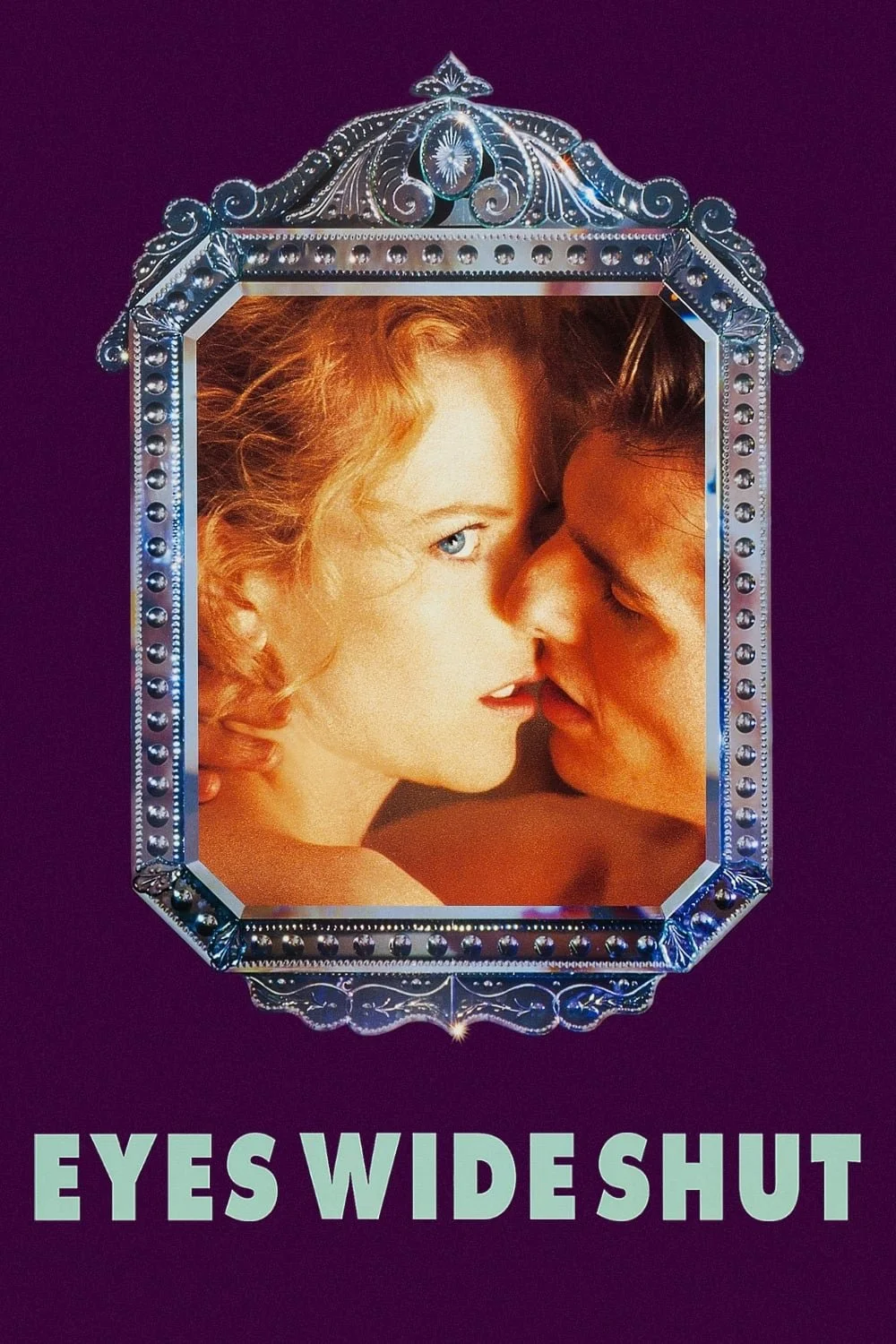
There are films that invite interpretation, and there are films that quietly reorganize the way one perceives reality after they end. Kubrick’s Eyes Wide Shut belongs unmistakably to the latter category. Its power does not lie simply in narrative revelation or dramatic escalation, but in a gradual accumulation of unease — a sensation that something fundamental about the world has been disclosed without ever being plainly stated, and it persists long after a viewing precisely because that disclosure emanates truth about the world around us all. And, while it’s a dark, sinister reality he unveils, it’s not all doom and gloom for Kubrick, because he masterfully expresses the inherent and fundamental flaw underlying that morose “elite” world.
Thus, for many viewers, the film appears opaque because it refuses conventional emotional guidance with a pacing that’s deliberate — even to the point of tangible discomfort. Conversations linger far beyond narrative necessity. Scenes unfold with a dreamlike opalescence, a stream-of-consciousness flow, rather than causal urgency common to modern storytelling. Yet this restraint is not ambiguity for its own sake, but, instead, Kubrick is constructing (or, as I would say, exposing) a philosophical environment in which meaning must be discovered through attention rather than delivered through explanation. Why? Because Kubrick is not interested in merely telling a story here, but in illuminating a very real truth to the reality in which we all find ourselves.
What emerges from that attention is startling. Beneath the film’s surface — beneath its marriage drama, erotic tension, and nocturnal wandering — lies a meditation on Transcendence and its absence as played out among the very leaders who should exemplify the best of humanity and yet rarely do. Eyes Wide Shut, then, depicts a society attempting to live as though God does not exist, yet simultaneously revealing humanity’s inability to abandon the structures of worship. What replaces transcendence is not freedom, but imitation: ritual without sanctity, hierarchy without moral grounding, desire elevated into ceremony.
The film’s true subject is therefore not simply jealousy or sexuality.
It is what fills the vacuum when the transcendent Good is denied. What takes over? What drives humanity then? What reigns in the worst of our impulses? What advises us to take unnoticed and unrewarded, or even detrimental, moral action?
BEAUTY AND THE INSTABILITY OF CERTAINTY
Kubrick begins with an image that appears deceptively simple: the absolutely stunning Alice Harford (as played by Nicole Kidman) standing before a mirror, undressing in warm domestic light. The shot lasts only moments, yet its placement is precise enough to function as a setting of the philosophical orientation of the film. Kidman’s presence is unmistakably, almost disarmingly beautiful, and Kubrick does nothing to diminish that fact. Quite the opposite, as Kidman is very often highlighted in sexual excess (though sometimes in subtle ways) throughout the film. In this shot, the lighting softens her outline while maintaining clarity, allowing attraction to exist without sensationalism.
The moment matters because it establishes desire as reality rather than disruption. Bill’s (played by Tom Cruise) world appears stable precisely because he assumes beauty belongs safely within possession — marriage, status, and familiarity. Alice’s later visceral confession reveals the fragility of that assumption. Why? Because desire exists independently of social structure; it cannot always be contained by comfort or moral self-confidence — but, of course, the point driven home by the end of the film is exactly that beauty and desire are best served among those confines under the True Transcendent.
Kubrick films their conversation with extraordinary patience. The camera holds longer than expected, forcing viewers into the discomfort Bill experiences as certainty dissolves. Nothing outwardly catastrophic occurs beyond spoken words and open engagement. Yet psychologically, the ground shifts completely and hits Bill like a tsunami. The revelation is not that Alice acted (in fact, she did not), but that she could have and desired sincerely to do so — that interior freedom remains inaccessible even within intimacy (a point, I would argue, that underscores Jesus’ own teaching about internal activity being just as sinful and traitorous as the external activity itself).
Bill’s subsequent wandering begins not as pursuit of pleasure but as an attempt to restore ontological stability. The overcoming of pure shuddering emotion that demands to be dealt with yet resists every attempt to address directly. Thus, he moves outward into the city seeking confirmation that reality still operates according to predictable, and beneficial, rules.
Instead, each encounter deepens uncertainty and threatens to finally shatter what should be a given truth: love as a product of beauty, desire, and connection is expressed most fully inside the marital bounds — as a possession born out of commitment and character.
THE CITY AS A FIELD OF SEDUCTION
New York in Eyes Wide Shut does not behave like a realistic city per se. Kubrick transforms it into a conglomerated representative liminal space suspended between waking life and dream. Christmas lights glow in nearly every frame, producing warmth that never quite becomes comfort. Reds and golds dominate interiors, while blues and purples cool exterior spaces, creating subtle emotional dissonance. And, so, while not realistic in a formal sense, Kubrick’s portrayal is realistic in the most important sense: the experience of reality as truth.
Cinematographically, Kubrick favors slow tracking shots and symmetrical compositions that lend ordinary environments ceremonial weight — something of foreshadowing as it turns out. Bill appears less like a man navigating a city than a participant unknowingly progressing through the stages and rites of initiation.
Each encounter presents temptation without coercion. Domino, the prostitute, is disarmingly gentle. The costume shop reveals corruption hidden beneath domestic normality. Social politeness opens doors more effectively than force ever could. But what do such paths deliver? As it turns out, things even worse than one could imagine.
The world Bill enters is not monstrous at first glance. It’s inviting. But as the film lingers on these meditations, the invitation inverts and becomes threat — a gilded iron maiden.
Kubrick’s insight here is essential for a proper unraveling of the rest of the film (and plausibly reality as Kubrick had seen it during his career): evil rarely announces itself through horror. Rather, it borrows the language of beauty, refinement, and exclusivity. The shadow becomes attractive precisely because it imitates the aesthetic coherence of the Good. It promises the fruits of perseverance without the tempering fire and stoic firmness normatively demanded in exchange for those fruits.
Bill is not dragged into darkness.
He is welcomed and steps forward, unknowingly, but willingly nonetheless.
DISCOVERING THE HIDDEN ORDER
The mansion sequence marks the transition from suggestion to revelation, yet Kubrick stages it without narrative sensationalism. The approach unfolds slowly, almost reverently. Long corridors resemble cathedral aisles. Textures and colors echo vestment and ordainment. Architecture, as opposed to reverence, imposes silence. Movement becomes deliberate and erotic.
The environment immediately communicates hierarchy, but with an unmistakable porcelain atmosphere. Participants play at understood roles without explanation. Authority emerges from ritual structure rather than visible enforcement.
Kubrick is not depicting conspiracy in the modern political sense. The sequence functions more accurately as some sort of liturgy — an organized reenactment of sacred order, but stripped of actual Transcendence. The red-cloaked figure presides not as tyrant but as priestly authority, guiding proceedings through ceremonial precision.
What the viewer witnesses is not indulgence masquerading as ritual, but ritual repurposed toward indulgence.
The distinction is crucial. Why? Because it delivers what I would argue is one of the key ideas of the film: inversion.
THE RITUAL EXAMINED
Kubrick devotes extraordinary screen time to the ceremony because it represents the film’s philosophical center.
Spatial Geometry
Participants form concentric circles, echoing religious architecture across cultures and eras. Movement follows symmetrical pathways that reinforce continuity and permanence. The geometry suggests eternity — yet here eternity is simulated rather than believed.
Masks and Identity
The masks do more than conceal faces. They dissolve individuality while preserving rank. Participants become roles within hierarchy rather than persons accountable for action. Kubrick’s camera lingers just long enough for viewers to recognize both beauty and emptiness, and even eeriness, within the imagery.
In sacred ritual, anonymity humbles the self before Transcendence.
Here anonymity removes moral consequence so that humility before any sort of Transcendence is scorned.
Sound and Chant
The reversed liturgical chant is deeply unsettling because it remains recognizable while unintelligible. The sound evokes prayer but denies comprehension, preserving structure while evacuating meaning. Kubrick transforms sacred language into aesthetic artifact — form without referent. In fact, this is probably one of my favorite scenes in the film specifically because it is without question alluring and haunting, beautiful in its own way, but, as what must be among the most truthful scenes in the film, it is also disturbing, dark, oppressive, evil, and perverted in the worst sense of those words. It chases one far into the small hours of the morning haze, weighing on the mind long after the final lines of the film have been delivered.
The viewer senses reverence occurring, yet cannot identify its object. Disorientation, as it turns out, is another of the key ideas in Eyes Wide Shut.
The Sexual Ceremony
Kubrick’s treatment of sexuality is strikingly restrained while simultaneously devotional in a way very few renditions ever achieve. Wide compositions prevent intimacy, emphasizing choreography over emotion. Bodies move according to pattern rather than connection. The camera observes rather than participates.
What should feel erotic instead feels procedural.
Pleasure is visible, yet strangely absent of vitality. Sexuality becomes institutional — organized, regulated, and depersonalized. Desire is no longer relational but administrative. In a word, it’s hedonism.
Kubrick reveals sexuality transformed into sacrament without Transcendence: a ritual attempting to generate meaning through repetition rather than love, and holds it up parallel to the scenes of household intimacy of Alice with Bill and those despairing and tormented mental intrusions Bill experiences of Alice and the Naval officer.
POWER WITHOUT TRANSCENDENCE
When Bill is exposed at the mansion, the society’s very real authority manifests through calm inevitability rather than outright violence. Dialogue remains measured. Threat emerges from certainty and composure rather than aggression. The participants behave as though moral law no longer applies within their domain, or, perhaps, as if they themselves have become the moral and judicial law.
Kubrick subtly lowers camera perspective, visually placing Bill beneath the assembly’s gaze. Architecture itself becomes enforcement as it looms far overhead and he shrinks beneath it despite his attempts to remain standing tall.
The society, then, cannot be said to reject Transcendence — and, as shown in the film, it evidently does not.
Quite the opposite, it behaves as though, and acts in belief that, it has replaced it.
Participants appear convinced they have ascended beyond ordinary moral constraints — initiated into a higher order inaccessible to outsiders.
THE LIMITS OF THE SHADOW
Yet Kubrick continually, and quite gorgeously, undermines this apparent supremacy. The ritual exists only in secrecy. Outside its walls, ordinary life continues, for the most part unchanged. Morning light dissolves ceremonial atmosphere instantly.
Alice sleeps peacefully while Bill wanders in existential disorientation. Domestic spaces retain warmth absent from the mansion’s grandeur.
The implication unfolds gradually: evil must hide because it lacks ontological independence. It imitates sacred structure but cannot sustain itself openly.
Its power derives from concealment, not creation. And this fact breaks open the lie it tells itself: that the Transcendent is not sole and supreme.
RETURN TO THE ORDINARY
The film concludes not with violent physical confrontation but recognition. Bill returns to ordinary reality altered by knowledge rather than action. The final conversation occurs in daylight, surrounded by toys — symbols of innocence and continuity.
Kubrick removes ritual lighting entirely. The dream dissolves.
Alice’s final line grounds the film in embodied life rather than abstraction. Existence continues through participation in reality rather than escape into hierarchy or illusion. Of course, Kubrick, as a master filmmaker and storyteller, doesn’t let the audience off just that easy. Alice’s final line to Bill about “fucking” itself haunts. It’s delivered as their daughter, Helena, wanders off unnoticed. It’s worth noting that Helena appears, at least to some viewers, to have been led away from Bill and Alice by two older men — it’s possible that Kubrick intended to embed yet another emphasis on the predatory and profane nature of the cult amongst whom Bill has found himself disarmed. In any case, Bill is left never to deliver a response to Alice. Alice’s declaration is spoken with a delivery of finality, but also with an undercurrent of almost duty in the face of spite — a hint of remorse, revulsion, but also an overture of seduction, possession, lust. It’s quite possibly one of the best lines in the film specifically because it definitively brings it all full circle with its focus on Alice and her place relative to Bill.
So, the dark society persists, but its metaphysical claim has been exposed as derivative and vacuous in the face of humanity’s oldest truth: love is bare and selfless relationship.
CONCLUSION: COUNTERFEIT TRANSCENDENCE
Eyes Wide Shut ultimately portrays a civilization attempting to live as though God does not exist while secretly reconstructing worship in distorted form. The human impulse toward Transcendence cannot be erased; it reappears as wealth, secrecy, sexuality, and ritualized power, but all in perverted and inverted form.
Kubrick’s final film suggests that evil does not destroy the sacred. It imitates it — borrowing beauty, hierarchy, and symbolism while lacking creative or ontological grounding.
The shadow seduces because it resembles the light.
Yet imitation reveals dependence.
The ritual ends. Morning remains.
And the ordinary world — imperfect, fragile, but real — endures beyond the spectacle that sought to replace it.
If you enjoyed this editorial, check out my piece on The Exorcist III — another film where evil is treated as serious but ultimately vacuous in the face of the power of good.
Please feel free to donate below or join as a patron over at Patreon as the site is 100% supported by donations/patrons at this time. Thank you!


EYES WIDE SHUT: KUBRICK’S ILLUMINATION OF THE ELITES’ DARK THEOLOGY