
The Exorcist III: Evil as Rebellion, Not Psychology
INTRO
Horror franchises rarely improve with age. More often, sequels dilute what made the original powerful, replacing moral weight with spectacle or metaphysical clarity with vagueness. The Exorcist series is a near-perfect example. The first film terrified audiences not because it was loud, but because it was serious. It treated evil as real, personal, and in open revolt against God. Its horror was theological before it was cinematic.
Most of the later entries drift away from that foundation. They lean toward mysticism, psychology, or visual excess (The Exorcist II being a prime example). Possession becomes a phenomenon to analyze away into mundanity rather than a genuine rebellion on the spiritual front to confront with directness. In short, evil becomes atmosphere rather than will. One sequel, however, does not make that mistake.
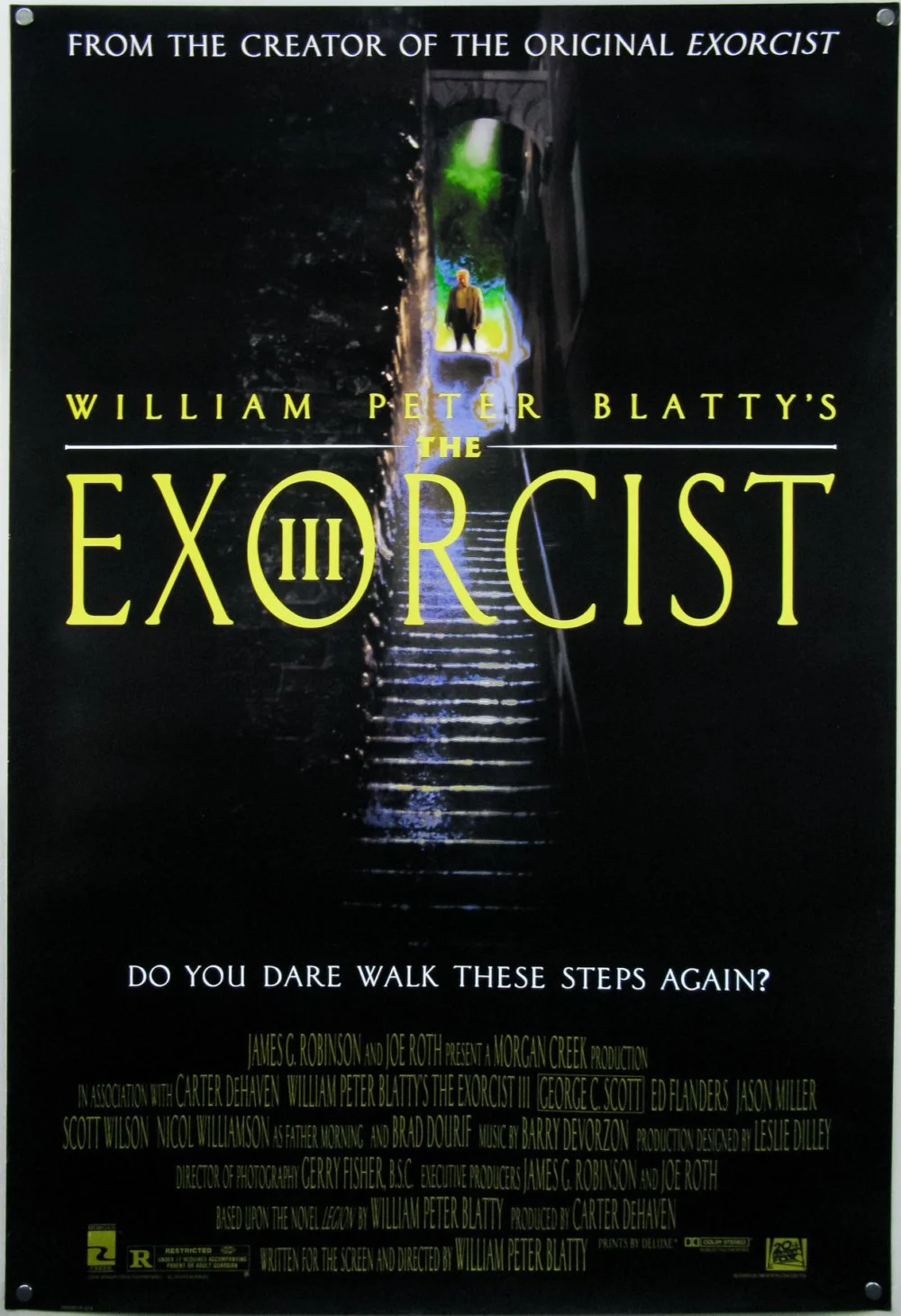
The Exorcist III, written and directed by William Peter Blatty, returns to the spiritual seriousness that made the original enduring. It works because it treats Christianity not as aesthetic backdrop or symbolic framework, but, accordingly, as the factual structure of reality. That single decision restores coherence, gravity, and genuine dread to a franchise that had, in extremely short order, discarded what had brought it success in the first place.
EVIL IS A PERSON, NOT A CONDITION
Modern horror often dissolves evil into inner fragmentation. Trauma itself becomes the haunting, repression becomes the monster to hunt, and grief becomes the ghost to put to rest. Those readings are tidy in their own way, but overall they are missteps which shrink the moral universe of a story — and in doing so eviscerate their applicability and similitude to reality. They turn spiritual conflict into psychology and, as a result, wind up actually saying nothing of weight whatever (not because psychology is vacuous in and of itself, but because these readings are erroneous vis-à-vis the subject matter itself). The Exorcist III, however, refuses that reduction outright.
The force operating through the Gemini Killer’s crimes is not merely a metaphor for institutional decay or existential despair; it is a dark intelligence that mocks, accuses, and delights in desecration. When it speaks, it does not sound like a symptom, but like hatred that ridicules faith, parodies sacred language, and takes pleasure in corrupting innocence. Notice, though, that is not the language of trauma — it is the voice of rebellion; a rebellion witnessed in scenes deliberately designed to evoke revulsion at the very intention of the act alongside the grotesqueness of the act itself.
The hospital murders themselves reinforce this intention. Victims are not chosen randomly but symbolically, their vulnerability becoming part of the desecration. The infamous corridor sequence — filmed in a single, patient wide shot — delays violence until the viewer’s sense of safety has fully settled, transforming anticipation itself into participation in the violation. The horror emerges not merely from surprise but from the realization that evil waits deliberately for trust to lower its guard.
Likewise, the cold, brutal murder of the young boy is carried out in such a way as to simultaneously deride the Passion and spiritual triumph of Christ on the Cross. This was crafted narratively precisely to stir in the viewer what is seen on-screen play out through the subsequent unfolding of Lieutenant Kinderman’s investigation: not confusion, but moral outrage at intentional profanation. As a result, the film demonstrates an understanding of a distinction many stories avoid: evil does not merely destroy life; it seeks to defile meaning. It inverts what is good, imitates in order to corrupt, and turns care into cruelty and trust into opportunistic vulnerability. This is not actually chaos, but, worse, malice with intent.
GOD IS NOT SYMBOLIC — HE IS SOVEREIGN
Then, of course, it could not be that God (in the film — though I believe in reality as well) is simply therapy, and thus the priests in this film are not to be taken as ritual therapists. Rather, they are individuals standing in a place of sincere authority, and their authority, then, is not to be understood as emotional confidence or psychological suggestion, but as tangible jurisdiction. When they invoke God, the film treats that appeal as a real appeal to the highest authority in existence.
Father Morning’s quiet presence reinforces this understanding. He is not portrayed as charismatic or theatrically powerful; instead, his authority derives from obedience and vocation. The exorcism unfolds not as spectacle but as legal confrontation, emphasizing that the struggle is not symbolic drama but jurisdictional conflict within a real metaphysical order. This is why the horror never collapses into nihilism. Evil is powerful, cunning, and vicious — but it is not ultimate. There is no cosmic balance here, no dualistic struggle between equal forces. The demon rages precisely because it is not sovereign. It can wound, mock, and torment, but it cannot overthrow reality itself.
That theological structure gives the story weight. The dread comes not from the idea that darkness is endless, but from the knowledge that rebellion against God is real, active, and desperate.
KARRAS: VESSEL VIOLATED, SOUL STILL FIGHTING
One of the most profound elements of The Exorcist III is its treatment of Father Karras. A lesser film would have used him as a simple shock device: the fallen priest, the holy man turned monster. But the film does something far more precise. It makes clear that his body became an empty vessel — that he had “slipped out” and had not yet crossed over. The demon occupies and repairs the body, using it as an instrument. But Karras himself is not erased. He returns. Not to live in peace, but to resist.
Brad Dourif’s performance as the Gemini Killer intensifies this distinction. The monologue scenes shift subtly in tone and posture, allowing glimpses of suffering beneath possession. The horror lies not only in what speaks, but in the implication that another consciousness remains trapped behind it. This distinction is crucial. The demon uses the body, but it does not own the man. Karras is not a conquered soul; he is a combatant trapped in a desecrated shell. The horror is not that a priest became evil. The horror is that a faithful man is still fighting from within unbearable confinement. That vision aligns with Christian spiritual reality: evil can assault, torment, and constrain — but it cannot simply erase God’s claim on a soul. The conflict is tragic, but it is not hopeless. It is warfare, not annihilation.
EVIL CANNOT CREATE — IT CAN ONLY CORRUPT
The murders in the film are not arbitrary acts of violence. They are chosen for symbolic desecration: the innocent, the vulnerable, spaces of care, roles of trust. The evil at work does not merely want bodies; it wants profanation. It turns hospitals into places of horror and vulnerability into opportunity. This follows a consistent spiritual logic. Evil does not create; it corrupts. In fact, it cannot truly originate anything at all. It has no creative power of its own, no generative capacity, no life-giving source. That is precisely why it must parasitize what already exists. It twists what is good because it cannot bring forth anything good — or anything at all — on its own. That is what makes it evil in the first place: it is privation turned predatory. The crimes in the film are therefore not random eruptions of chaos, but deliberate desecrations — acts of inversion aimed at profaning what should be sacred.
WHY THE OTHER SEQUELS FALL APART
Where The Exorcist III is spiritually and logically precise, the other sequels blur their metaphysics. Possession becomes psychic linkage. Evil becomes energy. Ritual becomes technique. Once that shift happens, the story loses both its theological grounding and its internal coherence. When evil is reduced to a phenomenon rather than a will, horror becomes atmospheric instead of existential. The stakes shrink. The fear becomes strange rather than serious. The Exorcist III succeeds because it refuses that drift. It understands that the original film was terrifying not because it was bizarre, but because it was sober about what evil is.
FORM AS MORAL ARGUMENT
Blatty reinforces these themes through form as well as story. Conversations linger. Silence weighs heavily. The camera often holds steady, allowing dread to grow not from chaos but from meaning. The famous hospital corridor scene is frightening not merely because of surprise, but because of what it represents: evil intruding into spaces of trust and care. Kinderman’s extended conversations — particularly his reflections on suffering, aging, and friendship — slow the film intentionally, grounding metaphysical horror in ordinary human experience. The pacing forces the audience to sit with death, with mystery, and with the limits of human understanding. The film never suggests that psychology alone can solve what is happening.
CONCLUSION: HORROR THAT RESPECTS REALITY
The Exorcist III endures because it does not shrink the spiritual dimension into metaphor. It presents a universe where God is real, evil is personal, authority is delegated, and rebellion has consequences. That framework gives the film coherence, gravity, and lasting power. It is not merely a story about fear. It is a story about truth — about what the world actually is, and about the kind of courage required to stand within it.
Where other sequels drift into vagueness or spectacle, The Exorcist III remains precise. It is horror grounded in ontology, not abstraction. And that is why, decades later, it still disturbs in a way noise never can. Watching it today, with reinterpretations stripped away and the film allowed to speak on its own terms, the message feels sharper than ever:
Evil is real.
Authority is real.
Truth is not symbolic.
And the fight is not imaginary.
If you enjoyed this editorial, check out my piece on why people misunderstand A Nightmare on Elm Street (1984) — another film where evil is far more moral, metaphysical, and real than modern readings allow.
Please feel free to donate below or join as a patron over at Patreon as the site is 100% supported by donations/patrons at this time. Thank you!

